
It's Time DOT SAP Services
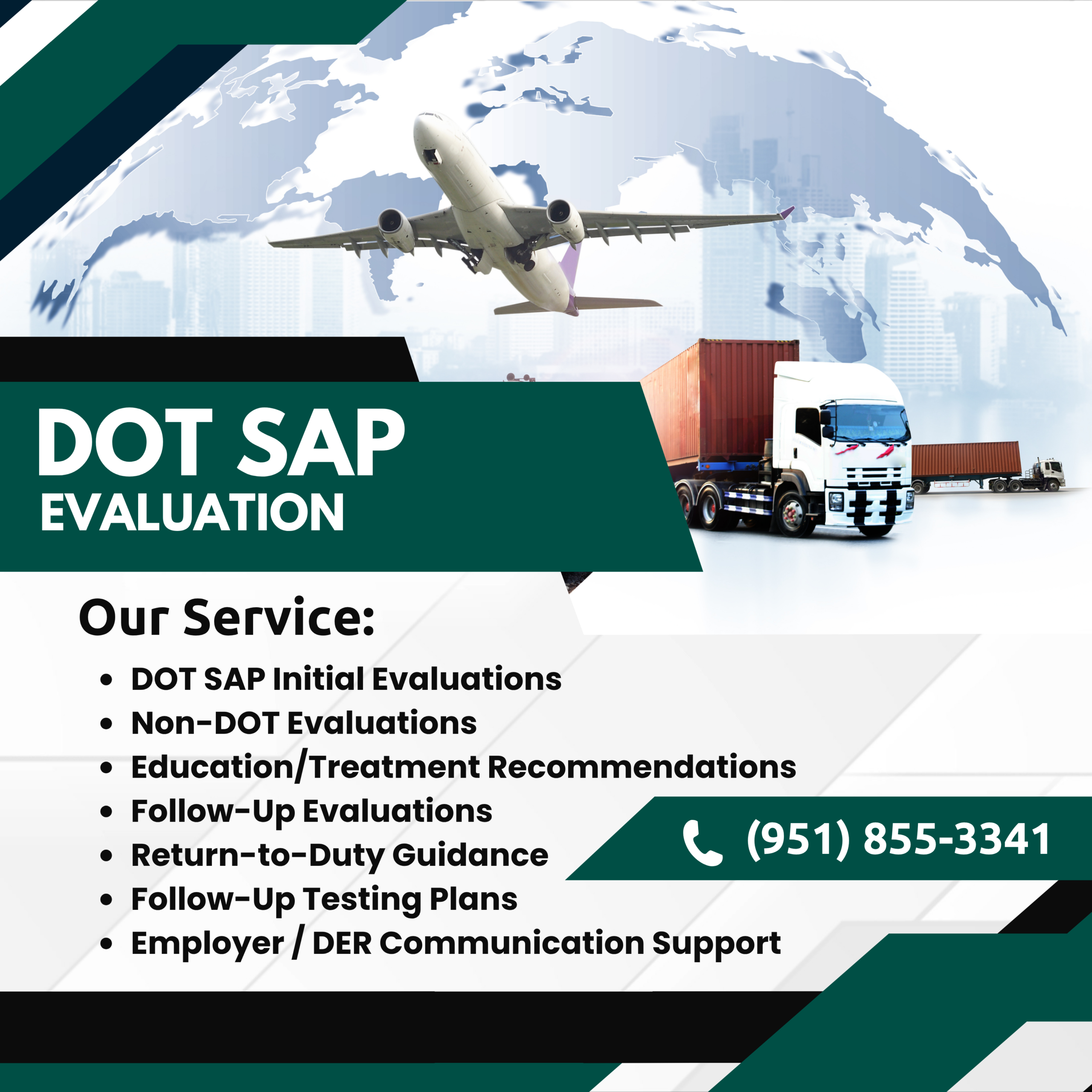
If a employee has a positive test result, a refusal to submit to testing, or a violation that doesn’t involve a test, they must complete a SAP return-to-duty process before returning to DOT safety-sensitive functions.
It’s Time SAP will help you find qualified SAPs so you can set up a face-to-face assessment.
It’s Time to Get Back to Work. We Can Help.
Return-to-Duty Process
If you’ve violated a DOT drug or alcohol test, the first step is calling a qualified SAP. We’ll guide you through the Return-to-Duty process—so you can move forward with confidence.
- Step 1: Initial SAP Evaluation
- Step 2: Complete Education and/or Treatment
- Step 3: Follow-Up SAP Evaluation
- Step 4: Return-to-Duty Drug and/or Alcohol Test
- Step 5: Return to Safety-Sensitive Duties
- Step 6: Follow-Up Testing Program
Trusted by
DOT Communities Nation Wide
25000 + Drivers Helped
Helping drivers complete the DOT return-to-duty process with confidence and compliance.
1,000+ Qualified SAPs
Providing access to experienced DOT-qualified SAP professionals across the nation.
20+ Years of Experience
Delivering trusted DOT compliance guidance backed by decades of industry expertise.
Nationwide SAP Network
Connecting drivers with qualified SAP providers quickly across the United States.
Talk to your DOT SAP Professional
Get the help you need to start your Return-to-Duty process today
Get appointment
Why Choose Us
DOT Qualified Substance Abuse Professional (SAP)
Internationally Certified Alcohol and Drug Counselor (ICADC)
Serving FMCSA, FAA, FRA, FTA, PHMSA, and USCG employees
Bilingual (English & Spanish) along withSame Day Appointments
Virtual appointments available along with Fast report turnaround
Serving individuals requiring Non-DOT SAP evaluations
SAP and Return-To-Duty Process
Frequently Asked Questions
-
1. I failed a drug test (or I have a refusal). What happens now?
If you violate a Department of Transportation drug or alcohol regulation, you will need to complete the return-to-duty process before being eligible to go back to work.
Until you complete a return-to-duty process, you are subject to federal civil and criminal penalties. -
2. (For FMCSA drivers only) What is the FMCSA Clearinghouse?
The FMCSA Clearinghouse is a national computerized database. Starting in 2020, all violations must be recorded on the Clearinghouse. A violation will remain on the Clearinghouse for at least 5 years, or until the driver has completed the SAP’s follow-up testing plan, whichever is later.
All FMCSA employers are required to check an applicant’s record on the Clearinghouse. An employer cannot hire a driver/applicant until a SAP indicates that the driver has successfully complied with the SAP’s treatment recommendation. -
3. My employer told me I have to find a SAP? How do I do this?
You can search for a qualified SAP in the Find a SAP directory.
-
4. If I have a violation, do I absolutely have see a SAP?
Yes. The DOT requires that a qualified and trained SAP evaluate every employee with a DOT violation.
-
5. Can I be evaluated by someone who is not a SAP?
No. An employer cannot accept recommendations from anyone who is not a qualified SAP.
-
6. Who is going to pay for my SAP services?
DOT does not specify who is responsible for the cost of SAP services. Some employers pay for them, or have arranged for SAP services to be covered by an Employee Assistance Program (EAP). But many employers require their employees to pay for SAP services. Your employer’s written policy should indicate whether they will pay, or if it’s your responsibility. If you’re not sure who will pay, ask your employer.
-
7. How much do SAP services cost?
Cost varies by SAP, and our website policy does not allow SAPs to list their fees. To find out a SAP’s fees, contact the SAP directly. In some cases, your workplace’s Employee Assistance Program (EAP) may cover SAP fees. In other cases, you will need to pay. Ask your employer for details. Health insurance typically doesn’t cover SAP assessments or follow-up appointments.
Many SAPs require full payment for their services in advance. If you are not able to provide the money at the first visit, a SAP may choose to not start the evaluation. Some SAPs will require payment in cash, money order or certified check. -
8. My employer gave me the name of phone number of a SAP. Must I use that SAP, or can I find another SAP?
Lorem ipsum dolor sAccording to DOT rules, your employer has the right to specify the SAP that employees must use. The reason is that your employer is ultimately responsible for anything that a SAP may do (or not do) under federal law, and your employer could be fined or face other penalties and sanctions by DOT, even if you selected a SAP on your own.it amet, consectetur adipiscing elit, sed do eiusmod tempor incididunt ut labore et dolore magna aliqua.
-
9. If I am terminating an employee, do I still need to provide a list of SAPs?
Yes. DOT requires the employer to provide SAP names and contact information, regardless of whether the employee is returning to safety-sensitive functions for you or not. If you are terminating the employee, but the employee intends to apply for another job in the transportation industry, successful completion of the DOT return-to-duty process is still required. The employee must receive SAP information from you, the employer that he/she was working for when the violation occurred.
DOT regulation 40.287 prohibits employers from charging an employee for a list of SAPs. -
10. As an employer, do I have to pay for an employee’s SAP services?
DOT doesn’t specify who must pay for SAP services. As an employer, you can decide if you will pay for these services or not. If you plan to make employees responsible for paying for SAP services, it’s advisable to include this in your written employee policy.
-
11. I need my employee back as soon as possible. How long will this SAP process take?
The process can take several weeks or even months. The SAP must conduct an extensive evaluation, which may require several visits with the employee. The SAP must then develop a plan for treatment and education, and do follow-up visits to verify that the employee is complying with the plan.
-
12. What happens if my employee doesn’t need treatment?
This isn’t possible. DOT rules prohibit a SAP from determining that an employee needs no treatment or education. The SAP must make a recommendation for treatment or education or both.
-
13. I’ve been told that SAPs need case managers to oversee what they are doing. Is this required by the DOT regulation?
The regulation does not mention the use of case managers. The practice of SAPs working under a case manager developed in the early days of this regulation, when some SAPs didn’t understand the rules and there was no requirement that they had to be trained. The addition of a case manager was important for quality assurance.
Assuming a SAP’s training met DOT’s requirements, and the SAP has the requisite professional skills and qualifications, the SAP should be able to work independently. However, you may feel more comfortable using a SAP who provides services under a case manager. The choice is yours. -
14. How do I know that the SAP I am using knows the rules?
Only trained SAPs who have passed an exam can provide SAP services. You can verify that a SAP has completed qualification training and the exam by viewing his or her SAPlist profile.
However, as an employer, you are ultimately responsible for ensuring that a SAP is properly credentialed, trained, and has passed an exam. DOT regulations give you the authority to request this information from each SAP that you use. You can ask a SAP to fax or mail copies of his/her training documentation to you, for your files. If the documentation you receive is questionable, you may request additional information, or you may decide to look for a different SAP. -
15. What if I think a SAP's recommendation is too harsh, or will take too long?
DOT gives full authority to a SAP to make decisions that are therapeutically appropriate. DOT also has made it very clear that a SAP’s primary responsibility is not to get an employee back to work, but rather to protect the safety of the traveling public. A SAP’s recommendation stands and no one can change it. Neither employers or employees are permitted to seek another assessment from a second SAP. (This is called “SAP shopping,” and is specifically prohibited by the regulation. [40.295])
-
16. What if I can’t wait for this employee any longer? Can I terminate him or her?
As the employer you may take whatever job action you want to take, considering, of course, any agreements or contracts that are relevant. If you terminate the employee, the employee will be free to seek employment with another DOT-covered employer, but only if he/she successfully completes the SAP’s recommended plan.